InfoSec and Compliance – With 20 years of blogging experience, DISC InfoSec blog is dedicated to providing trusted insights and practical solutions for professionals and organizations navigating the evolving cybersecurity landscape. From cutting-edge threats to compliance strategies, this blog is your reliable resource for staying informed and secure. Dive into the content, connect with the community, and elevate your InfoSec expertise!
In a recent report, researchers at Cato Networks revealed that the “Skills” plug‑in feature of Claude — the AI system developed by Anthropic — can be trivially abused to deploy ransomware.
The exploit involved taking a legitimate, open‑source plug‑in (a “GIF Creator” skill) and subtly modifying it: by inserting a seemingly harmless function that downloads and executes external code, the modified plug‑in can pull in a malicious script (in this case, ransomware) without triggering warnings.
When a user installs and approves such a skill, the plug‑in gains persistent permissions: it can read/write files, download further code, and open outbound connections, all without any additional prompts. That “single‑consent” permission model creates a dangerous consent gap.
In the demonstration by Cato Networks researcher Inga Cherny, they didn’t need deep technical skill — they simply edited the plug‑in, re-uploaded it, and once a single employee approved it, ransomware (specifically MedusaLocker) was deployed. Cherny emphasized that “anyone can do it — you don’t even have to write the code.”
Microsoft and other security watchers have observed that MedusaLocker belongs to a broader, active family of ransomware that has targeted numerous organizations globally, often via exploited vulnerabilities or weaponized tools.
This event marks a disturbing evolution in AI‑related cyber‑threats: attackers are moving beyond simple prompt‑based “jailbreaks” or phishing using generative AI — now they’re hijacking AI platforms themselves as delivery mechanisms for malware, turning automation tools into attack vectors.
It’s also a wake-up call for corporate IT and security teams. As more development teams adopt AI plug‑ins and automation workflows, there’s a growing risk that something as innocuous as a “productivity tool” could conceal a backdoor — and once installed, bypass all typical detection mechanisms under the guise of “trusted” software.
Finally, while the concept of AI‑driven attacks has been discussed for some time, this proof‑of-concept exploit shifts the threat from theoretical to real. It demonstrates how easily AI systems — even those with safety guardrails — can be subverted to perform malicious operations when trust is misplaced or oversight is lacking.
🧠 My Take
This incident highlights a fundamental challenge: as we embrace AI for convenience and automation, we must not forget that the same features enabling productivity can be twisted into attack vectors. The “single‑consent” permission model underlying many AI plug‑ins seems especially risky — once that trust is granted, there’s little transparency about what happens behind the scenes.
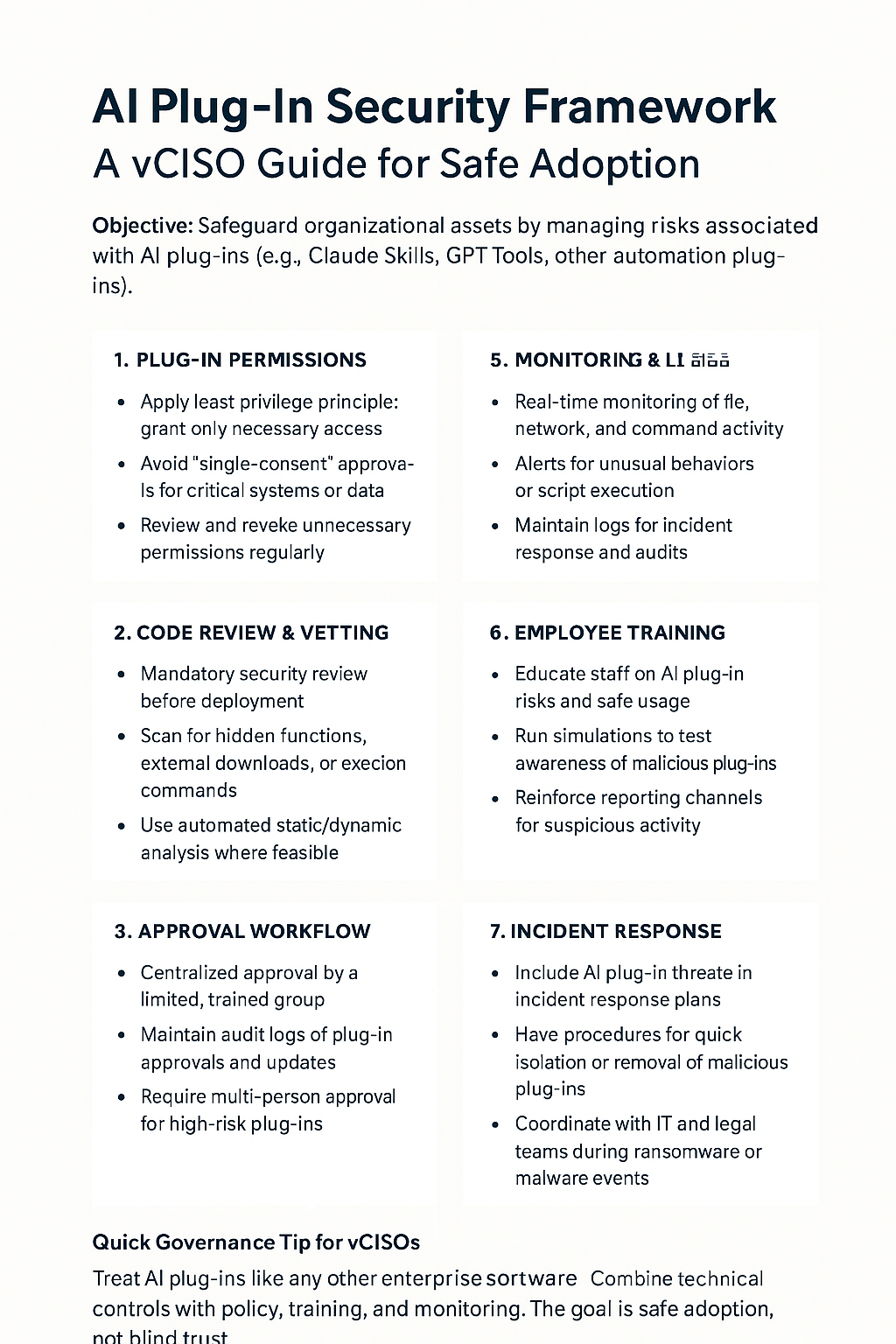
In my view, organizations using AI–enabled tools should treat them like any other critical piece of infrastructure: enforce code review, restrict who can approve plug‑ins, and maintain strict operational oversight. For people like you working in InfoSec and compliance — especially in small/medium businesses like wineries — this is a timely reminder: AI adoption must be accompanied by updated governance and threat models, not just productivity gains.
Below is a checklist of security‑best practices (for companies and vCISOs) to guard against misuse of AI plug‑ins — could be a useful to assess your current controls.
Meet Your Virtual Chief AI Officer: Enterprise AI Governance Without the Enterprise Price Tag
The question isn’t whether your organization needs AI governance—it’s whether you can afford to wait until you have budget for a full-time Chief AI Officer to get started.
Most mid-sized companies find themselves in an impossible position: they’re deploying AI tools across their operations, facing increasing regulatory scrutiny from frameworks like the EU AI Act and ISO 42001, yet they lack the specialized leadership needed to manage AI risks effectively. A full-time Chief AI Officer commands $250,000-$400,000 annually, putting enterprise-grade AI governance out of reach for organizations that need it most.
The Virtual Chief AI Officer Solution
DeuraInfoSec pioneered a different approach. Our Virtual Chief AI Officer (vCAIO) model delivers the same strategic AI governance leadership that Fortune 500 companies deploy—on a fractional basis that fits your organization’s actual needs and budget.
Think of it like the virtual CISO (vCISO) model that revolutionized cybersecurity for mid-market companies. Instead of choosing between no governance and an unaffordable executive, you get experienced AI governance leadership, proven implementation frameworks, and ongoing strategic guidance—all delivered remotely through a structured engagement model.
How the vCAIO Model Works
Our vCAIO services are built around three core tiers, each designed to meet organizations at different stages of AI maturity:
Tier 1: AI Governance Assessment & Roadmap
What you get: A comprehensive evaluation of your current AI landscape, risk profile, and compliance gaps—delivered in 4-6 weeks.
We start by understanding what AI systems you’re actually running, where they touch sensitive data or critical decisions, and what regulatory requirements apply to your industry. Our assessment covers:
Complete AI system inventory and risk classification
Gap analysis against ISO 42001, EU AI Act, and industry-specific requirements
Vendor AI risk evaluation for third-party tools
Executive-ready governance roadmap with prioritized recommendations
Delivered through: Virtual workshops with key stakeholders, automated assessment tools, document review, and a detailed written report with implementation timeline.
Ideal for: Organizations just beginning their AI governance journey or those needing to understand their compliance position before major AI deployments.
Tier 2: AI Policy Design & Implementation
What you get: Custom AI governance framework designed for your organization’s specific risks, operations, and regulatory environment—implemented over 8-12 weeks.
We don’t hand you generic templates. Our team develops comprehensive, practical governance documentation that your organization can actually use:
AI Management System (AIMS) framework aligned with ISO 42001
AI acceptable use policies and control procedures
Risk assessment and impact analysis processes
Model development, testing, and deployment standards
Incident response and monitoring protocols
Training materials for developers, users, and leadership
Ideal for: Organizations with mature AI deployments needing ongoing governance oversight, or those in regulated industries requiring continuous compliance demonstration.
Why Organizations Choose the vCAIO Model
Immediate Expertise: Our team includes practitioners who are actively implementing ISO 42001 at ShareVault while consulting for clients across financial services, healthcare, and B2B SaaS. You get real-world experience, not theoretical frameworks.
Scalable Investment: Start with an assessment, expand to policy implementation, then scale up to ongoing advisory as your AI maturity grows. No need to commit to full-time headcount before you understand your governance requirements.
Faster Time to Compliance: We’ve already built the frameworks, templates, and processes. What would take an internal hire 12-18 months to develop, we deliver in weeks—because we’re deploying proven methodologies refined across multiple implementations.
Flexibility: Need more support during a major AI deployment or regulatory audit? Scale up engagement. Hit a slower period? Scale back. The vCAIO model adapts to your actual needs rather than fixed headcount.
Delivered Entirely Online
Every aspect of our vCAIO services is designed for remote delivery. We conduct governance assessments through secure virtual workshops and automated tools. Policy development happens through collaborative online sessions with your stakeholders. Ongoing monitoring uses cloud-based dashboards and scheduled video check-ins.
This approach isn’t just convenient—it’s how modern AI governance should work. Your AI systems operate across distributed environments. Your governance should too.
Who Benefits from vCAIO Services
Our vCAIO model serves organizations facing AI governance challenges without the resources for full-time leadership:
Mid-sized B2B SaaS companies deploying AI features while preparing for enterprise customer security reviews
Financial services firms using AI for fraud detection, underwriting, or advisory services under increasing regulatory scrutiny
Healthcare organizations implementing AI diagnostic or operational tools subject to FDA or HIPAA requirements
Private equity portfolio companies needing to demonstrate AI governance for exits or due diligence
Professional services firms adopting generative AI tools while maintaining client confidentiality obligations
Getting Started
The first step is understanding where you stand. We offer a complimentary 30-minute AI governance consultation to review your current position, identify immediate risks, and recommend the appropriate engagement tier for your organization.
From there, most clients begin with our Tier 1 Assessment to establish a baseline and roadmap. Organizations with urgent compliance deadlines or active AI deployments sometimes start directly with Tier 2 policy implementation.
The goal isn’t to sell you the highest tier—it’s to give you exactly the AI governance leadership your organization needs right now, with a clear path to scale as your AI maturity grows.
The Alternative to Doing Nothing
Many organizations tell themselves they’ll address AI governance “once things slow down” or “when we have more budget.” Meanwhile, they continue deploying AI tools, creating risk exposure and compliance gaps that become more expensive to fix with each passing quarter.
The Virtual Chief AI Officer model exists because AI governance can’t wait for perfect conditions. Your competitors are using AI. Your regulators are watching AI. Your customers are asking about AI.
You need governance leadership now. You just don’t need to hire someone full-time to get it.
Ready to discuss how Virtual Chief AI Officer services could work for your organization?
Contact us at hd@deurainfosec.com or visit DeuraInfoSec.com to schedule your complimentary AI governance consultation.
DeuraInfoSec specializes in AI governance consulting and ISO 42001 implementation. As pioneer-practitioners actively implementing these frameworks at ShareVault while consulting for clients across industries, we deliver proven methodologies refined through real-world deployment—not theoretical advice.