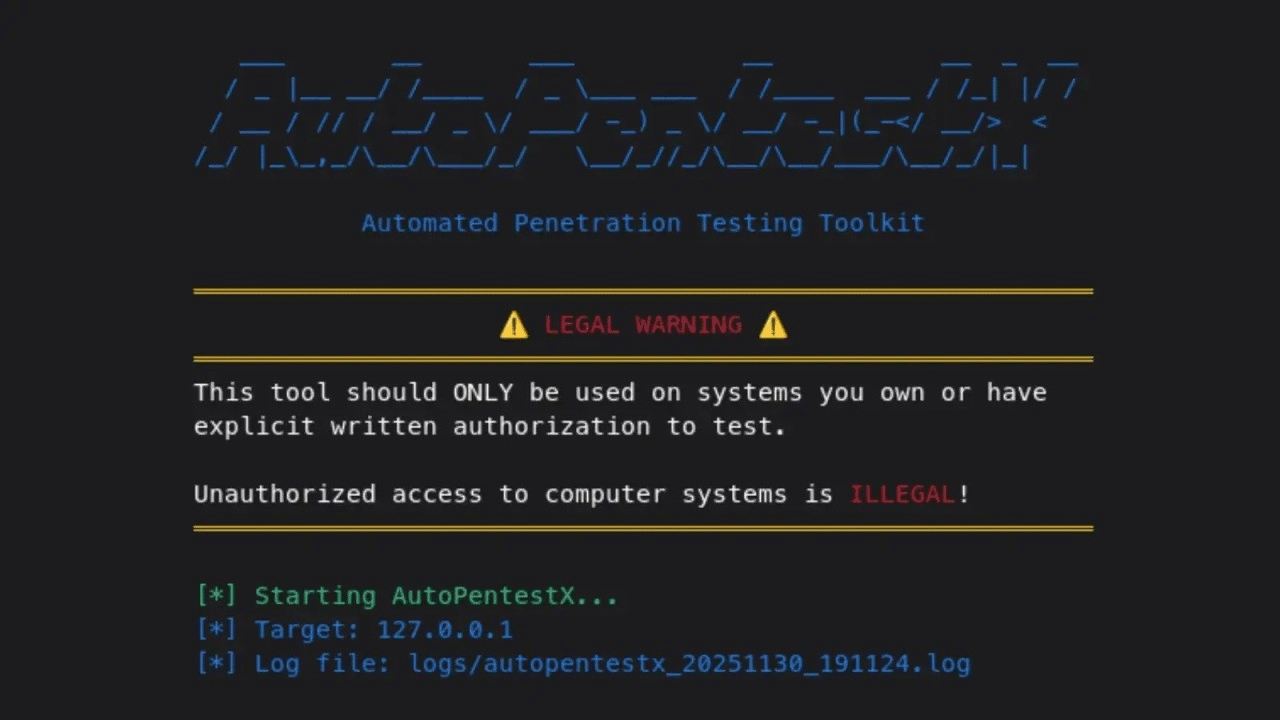
AutoPentestX is an open-source automated penetration testing framework that brings multiple security testing capabilities into a single, unified platform for Linux environments. Designed for ethical hacking and security auditing, it aims to simplify and accelerate penetration testing by removing much of the manual setup traditionally required.
Created by security researcher Gowtham-Darkseid, AutoPentestX orchestrates reconnaissance, scanning, exploitation, and reporting through a centralized interface. Instead of forcing security teams to manually chain together multiple tools, the framework automates the end-to-end workflow, allowing comprehensive vulnerability assessments to run with minimal ongoing operator involvement.
A key strength of AutoPentestX is how it addresses inefficiencies in traditional penetration testing processes. By automating reconnaissance and vulnerability discovery across target systems, it reduces operational overhead while preserving the depth and coverage expected in enterprise-grade security assessments.
The framework follows a modular architecture that integrates well-known security tools into coordinated testing workflows. It performs network enumeration, service discovery, and vulnerability identification, then generates structured reports detailing findings, attempted exploitations, and overall security posture.
AutoPentestX supports both command-line execution and Python-based automation, giving security professionals flexibility to integrate it into different environments and CI/CD or testing pipelines. All activities are automatically logged with timestamps and stored in organized directories, creating a clear audit trail that supports compliance, internal reviews, and post-engagement analysis.
Built using Python 3.x and Bash, the framework runs natively on Linux distributions such as Kali Linux, Ubuntu, and Debian-based systems. Installation is handled via an install script that manages dependencies and prepares the required directory structure.
Configuration is driven through a central JSON file, allowing users to fine-tune scan intensity, targets, and reporting behavior. Its structured layout—separating exploits, modules, and reports—also makes it easy to extend the framework with custom modules or integrate additional external tools.
My Perspective
AutoPentestX reflects a broader shift toward AI-adjacent and automation-first security operations, where efficiency and repeatability are becoming just as important as technical depth. For modern security teams—especially those operating under compliance pressure—automation like this can significantly improve coverage and consistency.
However, tools like AutoPentestX should be viewed as force multipliers, not replacements for skilled testers. Automated frameworks excel at scale, baseline assessments, and documentation, but human expertise is still critical for contextual risk analysis, business impact evaluation, and creative attack paths. Used correctly, AutoPentestX fits well into a continuous security testing and risk-driven assessment model, especially for organizations embracing DevSecOps and ongoing assurance rather than point-in-time pentests.

InfoSec services | InfoSec books | Follow our blog | DISC llc is listed on The vCISO Directory | ISO 27k Chat bot | Comprehensive vCISO Services | ISMS Services | AIMS Services | Security Risk Assessment Services | Mergers and Acquisition Security
At DISC InfoSec, we help organizations navigate this landscape by aligning AI risk management, governance, security, and compliance into a single, practical roadmap. Whether you are experimenting with AI or deploying it at scale, we help you choose and operationalize the right frameworks to reduce risk and build trust. Learn more at DISC InfoSec.
- Security Is a People Problem: Culture, Behavior, and Decisions Drive Cyber Resilience
- Security Driven by Business Value: Focus, Prioritize, Protect What Matters Most
- Claude Mythos and the Future of Cybersecurity: Powerful—and Potentially Dangerous
- Hackers at Machine Speed: The AI Cybersecurity Reality
- AI Security = API Security: The Case for Real-Time Enforcement