
Below are 15 top Kali Linux tools and how they can be applied to AI governance use cases (risk, compliance, model security, data protection).
🔐 Top 15 Kali Linux Tools for AI Governance (with Use Cases)
1. Nmap
Use: Discover AI infrastructure
AI Governance Example:
Scan AI model hosting environments to ensure:
- No unauthorized ports are open
- APIs serving models aren’t exposed publicly
👉 Helps enforce secure AI deployment (ISO 42001 / NIST AI RMF – MAP & MANAGE)
2. Wireshark
Use: Monitor network traffic
AI Governance Example:
Inspect traffic between:
- AI models and external APIs
- Data pipelines
👉 Detect data leakage from LLM prompts or outputs
3. Burp Suite
Use: Test APIs and web apps
AI Governance Example:
Test AI APIs for:
- Prompt injection vulnerabilities
- Insecure input validation
👉 Critical for LLM application security
4. OWASP ZAP
Use: Automated web scanning
AI Governance Example:
Scan AI dashboards or model interfaces for:
- XSS, injection, auth flaws
👉 Ensures secure AI interfaces (governance + compliance)
5. Metasploit
Use: Exploitation framework
AI Governance Example:
Simulate attacks on:
- AI infrastructure
- Model hosting environments
👉 Validates resilience of AI systems against real threats
6. Maltego
Use: Data relationship mapping
AI Governance Example:
Map:
- AI vendors
- Data sources
- Third-party dependencies
👉 Supports AI supply chain risk management
7. theHarvester
Use: Collect public data
AI Governance Example:
Identify:
- Exposed datasets
- Public AI endpoints
👉 Helps detect unintentional data exposure
8. John the Ripper
Use: Password strength testing
AI Governance Example:
Test credentials protecting:
- AI model dashboards
- Data pipelines
👉 Enforces access control governance
9. Hydra
Use: Brute-force authentication
AI Governance Example:
Test AI systems for:
- Weak authentication mechanisms
👉 Supports identity & access management controls
10. Aircrack-ng
Use: Wireless testing
AI Governance Example:
Secure environments where:
- Edge AI devices operate (IoT, wineries, sensors)
👉 Prevents data interception in AI pipelines
11. Sqlmap
Use: Database exploitation
AI Governance Example:
Test backend databases storing:
- Training data
- Model outputs
👉 Prevents data poisoning or leakage risks
12. Nikto
Use: Server vulnerability scanning
AI Governance Example:
Scan AI hosting servers for:
- Misconfigurations
- Outdated components
👉 Ensures secure AI infrastructure baseline
13. Gobuster
Use: Discover hidden endpoints
AI Governance Example:
Find:
- Undocumented AI APIs
- Hidden model endpoints
👉 Helps identify shadow AI systems (huge governance gap)
14. Responder
Use: Credential interception
AI Governance Example:
Test internal AI environments for:
- Credential leakage risks
👉 Supports insider threat and lateral movement controls
15. Hashcat
Use: Advanced password cracking
AI Governance Example:
Audit password policies protecting:
- AI training pipelines
- Model repositories
👉 Strengthens AI system access governance
🧠 How This Fits AI Governance
These tools map directly to AI governance domains:
1. Security of AI Systems
- Nmap, Metasploit, Nikto
👉 Infrastructure security
2. Data Governance
- Wireshark, Sqlmap
👉 Prevent leakage, poisoning
3. Model & API Security
- Burp Suite, OWASP ZAP, Gobuster
👉 Protect LLM interfaces
4. Access & Identity
- Hydra, John the Ripper, Hashcat
👉 Enforce IAM controls
5. Third-Party & Supply Chain Risk
- Maltego, theHarvester
👉 Vendor & data source visibility
vCISO offering —mapping offensive security validation to AI governance controls.
Below is a practical mapping of the 15 Kali Linux tools to ISO/IEC 42001 Annex controls, with a focus on evidence-driven AI governance.
🔗 Mapping: Kali Tools → ISO 42001 Annex Controls
1. Asset & AI System Inventory Controls
Relevant Annex Areas:
- A.5 (AI system inventory & lifecycle management)
Tools:
- Nmap
- Gobuster
- theHarvester
How they support controls:
- Discover undocumented AI endpoints and shadow AI systems
- Identify exposed APIs and infrastructure
- Validate completeness of AI asset inventory
👉 Audit Evidence:
“Discovered vs documented AI systems reconciliation report”
2. Access Control & Identity Management
Relevant Annex Areas:
- A.9 (Access control)
Tools:
- Hydra
- John the Ripper
- Hashcat
- Responder
How they support controls:
- Test authentication strength of AI systems
- Identify weak credentials and privilege escalation risks
- Validate enforcement of least privilege
👉 Audit Evidence:
“Credential strength and authentication resilience report”
3. Data Governance & Protection
Relevant Annex Areas:
- A.7 (Data management for AI systems)
Tools:
- Wireshark
- Sqlmap
How they support controls:
- Detect sensitive data leakage in AI pipelines
- Test exposure of training datasets and inference outputs
- Validate protection against data exfiltration and poisoning
👉 Audit Evidence:
“AI data flow inspection and leakage analysis”
4. AI System Security & Robustness
Relevant Annex Areas:
- A.8 (AI system robustness, accuracy, and security)
Tools:
- Metasploit
- Nikto
- Aircrack-ng
How they support controls:
- Simulate attacks on AI infrastructure
- Identify vulnerabilities in model hosting environments
- Test resilience of edge AI systems (IoT, sensors, etc.)
👉 Audit Evidence:
“AI infrastructure penetration testing report”
5. Application & API Security (LLMs / AI Interfaces)
Relevant Annex Areas:
- A.8 (system security)
- A.6 (AI system requirements & design)
Tools:
- Burp Suite
- OWASP ZAP
How they support controls:
- Test AI APIs for:
- Prompt injection
- Input manipulation
- Output leakage
- Validate secure design of AI interfaces
👉 Audit Evidence:
“AI API security and prompt injection testing report”
6. Third-Party & Supply Chain Risk
Relevant Annex Areas:
- A.10 (Supplier relationships for AI systems)
Tools:
- Maltego
- theHarvester
How they support controls:
- Map AI vendors and external dependencies
- Identify exposure of third-party AI services
- Validate supplier risk visibility
👉 Audit Evidence:
“AI vendor dependency and exposure map”
7. Monitoring, Logging & Continuous Assurance
Relevant Annex Areas:
- A.12 (Monitoring and logging) (aligned conceptually from ISO 27001 lineage)
Tools:
- Wireshark
- Nmap
How they support controls:
- Monitor runtime AI behavior
- Detect anomalies in AI communications
- Validate logging and traceability
👉 Audit Evidence:
“AI system monitoring and anomaly detection logs”
✅ Consolidated View
| Control Area | ISO 42001 Annex | Tools | Outcome |
|---|---|---|---|
| Asset Inventory | A.5 | Nmap, Gobuster, theHarvester | Discover shadow AI |
| Access Control | A.9 | Hydra, John, Hashcat, Responder | Validate IAM |
| Data Governance | A.7 | Wireshark, Sqlmap | Prevent leakage |
| System Security | A.8 | Metasploit, Nikto, Aircrack-ng | Test resilience |
| API Security | A.6/A.8 | Burp, ZAP | Secure LLM interfaces |
| Supply Chain | A.10 | Maltego, theHarvester | Vendor risk visibility |
| Monitoring | A.12 | Wireshark, Nmap | Continuous assurance |
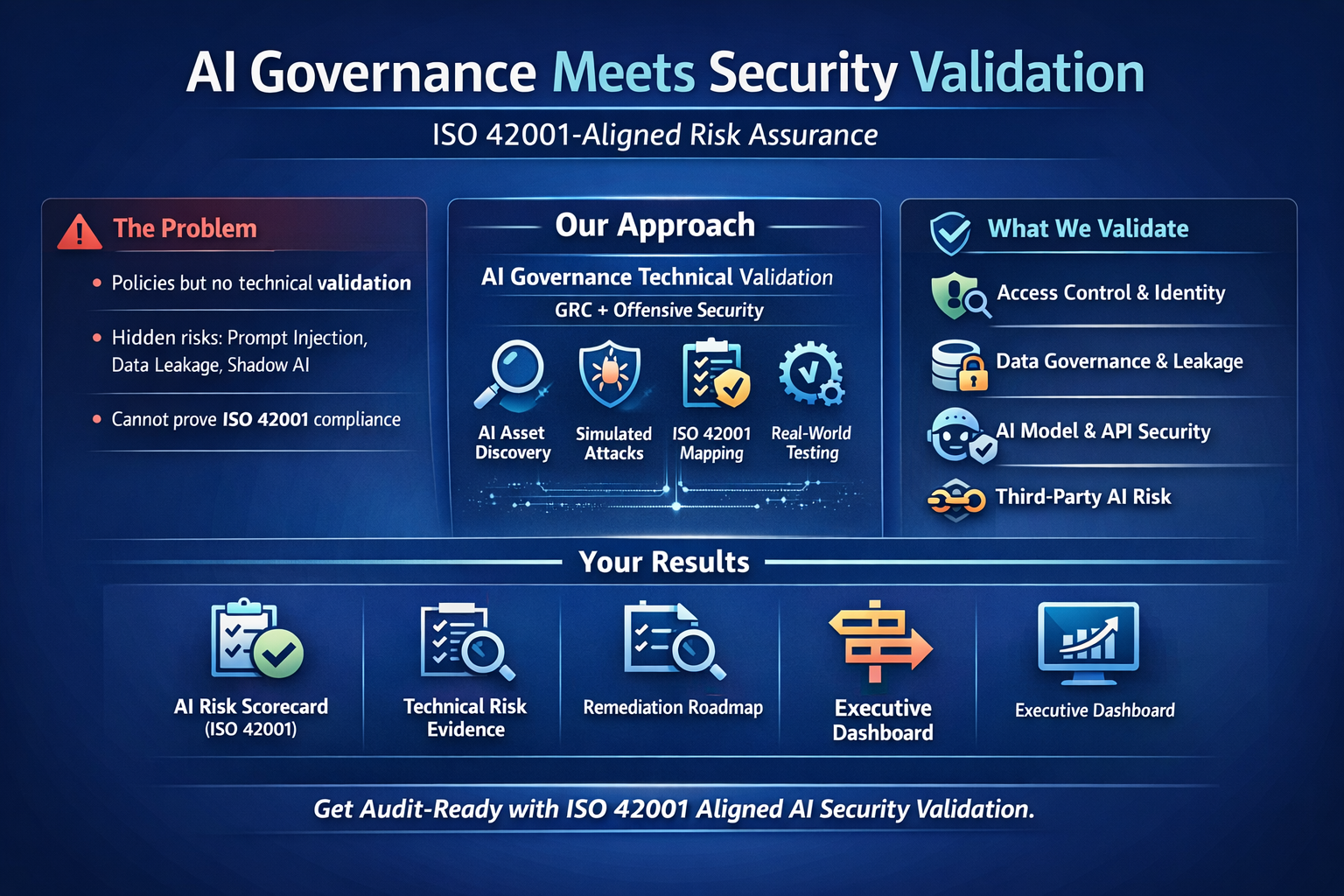
Title:
AI Governance Meets Security Validation
ISO 42001-Aligned Risk Assurance
The Problem
- AI governance programs are policy-heavy but lack technical validation
- Hidden risks: prompt injection, data leakage, shadow AI, insecure APIs
- No clear way to prove compliance with ISO 42001 controls
Our Approach
AI Governance Technical Validation (GRC + Offensive Security)
- Discover AI assets, models, and APIs
- Test real-world risks (LLMs, data pipelines, infra)
- Simulate attacks using proven security tools
- Map findings directly to ISO 42001 Annex controls
What We Validate
- 🔐 Access Control & Identity (weak auth, privilege risks)
- 📊 Data Governance (leakage, poisoning, exposure)
- 🤖 AI Model & API Security (prompt injection, misuse)
- 🌐 Infrastructure Security (hosting, endpoints, networks)
- 🔗 Third-Party AI Risk (vendors, dependencies)
What You Get
- ✅ AI Risk Scorecard (ISO 42001-aligned)
- ✅ Technical Risk Evidence (not just policies)
- ✅ Prioritized Remediation Roadmap
- ✅ Executive Dashboard for leadership
Business Impact
- Reduce AI-related security and compliance risk
- Achieve audit readiness for ISO 42001
- Gain confidence in AI deployments
- Bridge GRC + real-world security testing
Call to Action
Request a demo to see how we dynamically map AI risks to ISO 42001 controls and provide audit-ready validation.

InfoSec services | InfoSec books | Follow our blog | DISC llc is listed on The vCISO Directory | ISO 27k Chat bot | Comprehensive vCISO Services | ISMS Services | AIMS Services | Security Risk Assessment Services | Mergers and Acquisition Security
At DISC InfoSec, we help organizations navigate this landscape by aligning AI risk management, governance, security, and compliance into a single, practical roadmap. Whether you are experimenting with AI or deploying it at scale, we help you choose and operationalize the right frameworks to reduce risk and build trust. Learn more at DISC InfoSec.
- The Evidence Lifecycle: Which Organizational Events to Log for Liability — and How Long to Keep Them
- 14 Months to Comply. 12 Months of Work. The High-Risk AI Playbook Nobody Has Started
- Your biggest AI risk isn’t hackers. It’s your own data walking out the door
- The cheapest security control you’ll ever implement is the component you decided not to build
- AI Handoffs: How Uncertainty Propagates—and How to Fix It





