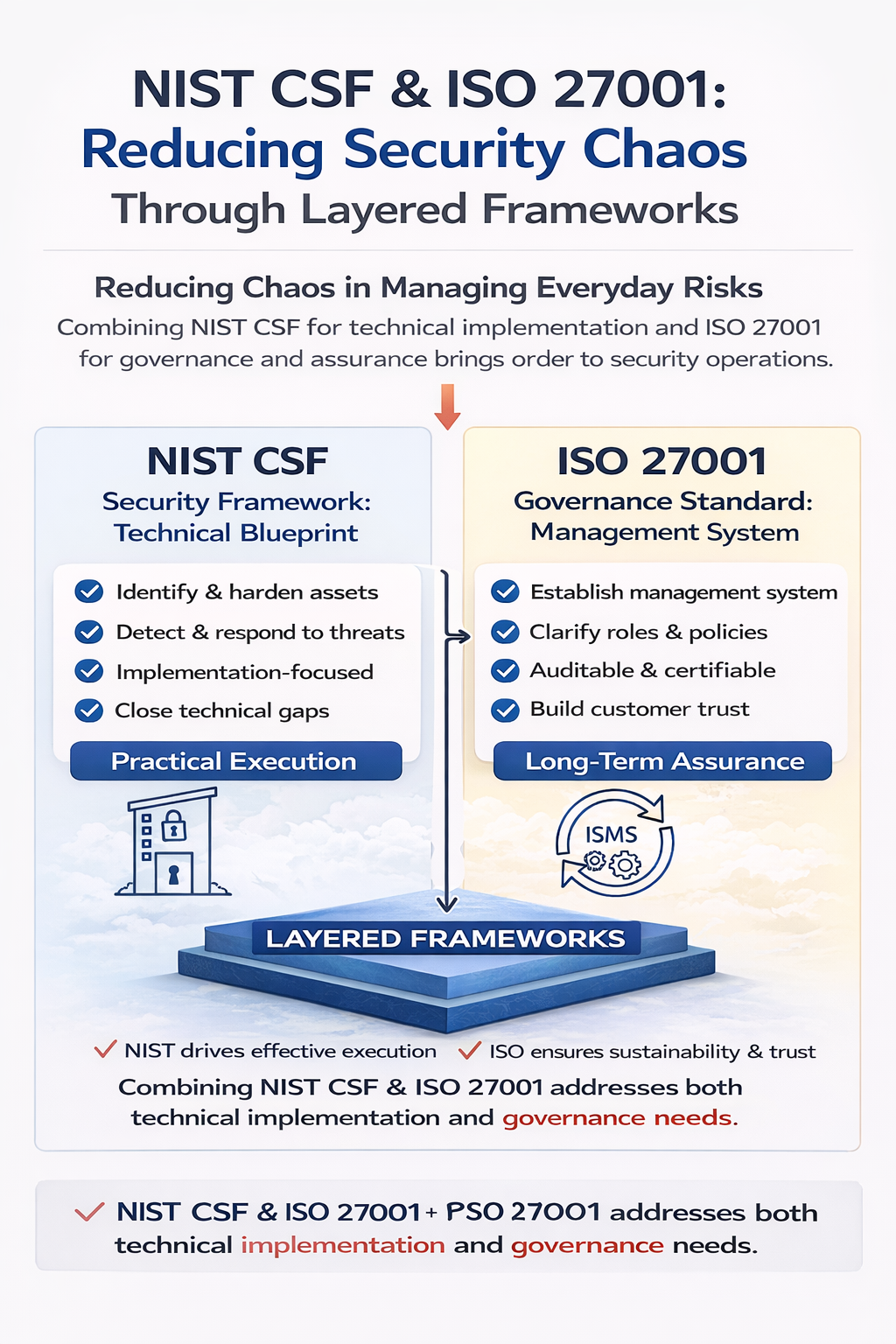
Security frameworks exist to reduce chaos in how organizations manage risk. Without a shared structure, every company invents its own way of “doing security,” which leads to inconsistent controls, unclear responsibilities, and hidden blind spots. This post illustrates how two major frameworks — National Institute of Standards and Technology’s Cybersecurity Framework (NIST CSF) and International Organization for Standardization’s ISO/IEC 27001 — approach this challenge from complementary angles. Together, they bring order to everyday security operations by defining both what to protect and how to manage protection over time.
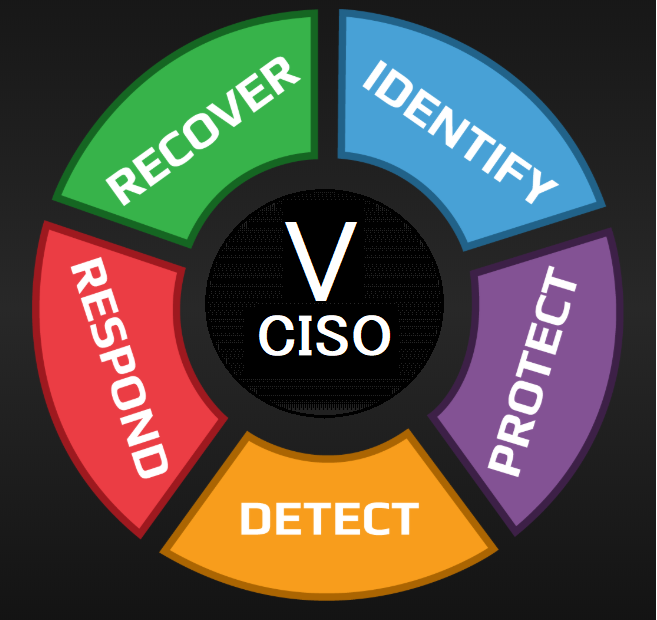
The NIST CSF acts like a master technical architect. It provides a practical blueprint for implementing safeguards: identifying assets, protecting systems, detecting threats, responding to incidents, and recovering from disruptions. Its strength lies in being implementation-focused and highly actionable. Organizations use NIST to harden their environment, close technical gaps, and standardize best practices. By offering a common language and structured set of controls, NIST reduces operational confusion, aligns teams around clear priorities, and makes day-to-day risk management more predictable and measurable.
ISO/IEC 27001, on the other hand, focuses on governance and sustainability. Rather than concentrating on specific technical controls, it builds a management system — an Information Security Management System (ISMS) — that ensures security processes are repeatable, accountable, and continuously improved. It defines roles, policies, oversight mechanisms, and audit structures that keep security running as a disciplined business function. Certification under ISO 27001 signals assurance and trust to customers and stakeholders. In practical terms, ISO reduces chaos by embedding security into organizational routines, clarifying ownership, and ensuring that protections don’t fade over time.
When layered together, these frameworks create a powerful system. NIST provides the technical depth to design and operationalize safeguards, while ISO 27001 supplies the governance engine that sustains them. Mature organizations rarely treat this as an either-or decision. They use NIST to shape their technical security architecture and ISO 27001 to institutionalize it through management processes and external assurance. This layered approach addresses both technical risk and trust risk — the need to protect systems and the need to prove that protection is consistently maintained.
From my perspective, asking whether we need both frameworks is really a question about organizational maturity and goals. If a company is struggling with technical implementation, NIST offers immediate practical guidance. If it needs to demonstrate credibility and long-term governance, ISO 27001 becomes essential. In reality, most organizations benefit from combining them: NIST drives effective execution, and ISO ensures durability and trust. Together, they transform security from a reactive set of tasks into a structured, sustainable discipline that meaningfully reduces everyday operational chaos.
InfoSec services | InfoSec books | Follow our blog | DISC llc is listed on The vCISO Directory | ISO 27k Chat bot | Comprehensive vCISO Services | ISMS Services | AIMS Services | Security Risk Assessment Services | Mergers and Acquisition Security
At DISC InfoSec, we help organizations navigate this landscape by aligning AI risk management, governance, security, and compliance into a single, practical roadmap. Whether you are experimenting with AI or deploying it at scale, we help you choose and operationalize the right frameworks to reduce risk and build trust. Learn more at DISC InfoSec.
- AI Handoffs: How Uncertainty Propagates—and How to Fix It
- The Security Risks Hiding in AI Agent Memory
- AI Log Retention: Why Every AI Log Doesn’t Deserve the Same Shelf Life
- The AI Agent Harness Is the New Security Boundary
- Stop asking what your agent can do