
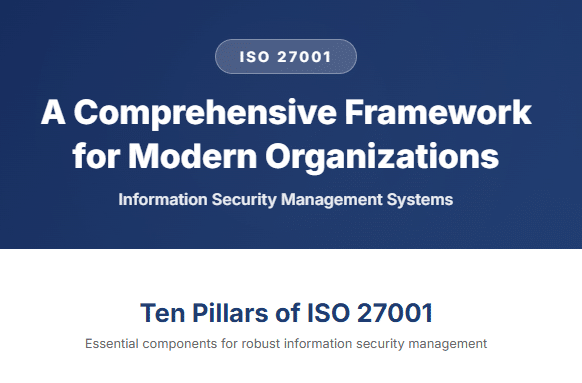
ISO 27001: Information Security Management Systems
Overview and Purpose
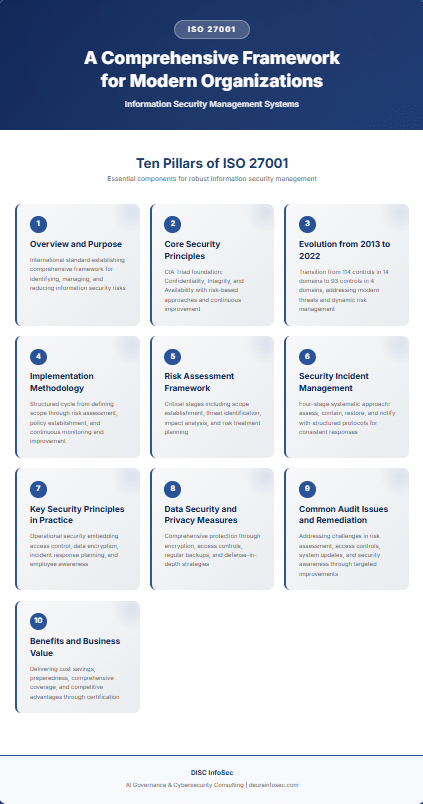
ISO 27001 represents the international standard for Information Security Management Systems (ISMS), establishing a comprehensive framework that enables organizations to systematically identify, manage, and reduce information security risks. The standard applies universally to all types of information, whether digital or physical, making it relevant across industries and organizational sizes. By adopting ISO 27001, organizations demonstrate their commitment to protecting sensitive data and maintaining robust security practices that align with global best practices.
Core Security Principles
The foundation of ISO 27001 rests on three fundamental principles known as the CIA Triad. Confidentiality ensures that information remains accessible only to authorized individuals, preventing unauthorized disclosure. Integrity maintains the accuracy, completeness, and reliability of data throughout its lifecycle. Availability guarantees that information and systems remain accessible when required by authorized users. These principles work together to create a holistic approach to information security, with additional emphasis on risk-based approaches and continuous improvement as essential methodologies for maintaining effective security controls.
Evolution from 2013 to 2022
The transition from ISO 27001:2013 to ISO 27001:2022 brought significant updates to the standard’s control framework. The 2013 version organized controls into 14 domains covering 114 individual controls, while the 2022 revision restructured these into 93 controls across 4 domains, eliminating fragmented controls and introducing new requirements. The updated version shifted from compliance-driven, static risk treatment to dynamic risk management, placed greater emphasis on business continuity and organizational resilience, and introduced entirely new controls addressing modern threats such as threat intelligence, ICT readiness, data masking, secure coding, cloud security, and web filtering.
Implementation Methodology
Implementing ISO 27001 follows a structured cycle beginning with defining the scope by identifying boundaries, assets, and stakeholders. Organizations then conduct thorough risk assessments to identify threats, vulnerabilities, and map risks to affected assets and business processes. This leads to establishing ISMS policies that set security objectives and demonstrate organizational commitment. The cycle continues with sustaining and monitoring through internal and external audits, implementing security controls with protective strategies, and maintaining continuous monitoring and review of risks while implementing ongoing security improvements.
Risk Assessment Framework
The risk assessment process comprises several critical stages that form the backbone of ISO 27001 compliance. Organizations must first establish scope by determining which information assets and risk assessment criteria require protection, considering impact, likelihood, and risk levels. The identification phase requires cataloging potential threats, vulnerabilities, and mapping risks to affected assets and business processes. Analysis and evaluation involve determining likelihood and assessing impact including financial exposure, reputational damage, and utilizing risk matrices. Finally, defining risk treatment plans requires selecting appropriate responses—avoiding, mitigating, transferring, or accepting risks—documenting treatment actions, assigning teams, and establishing timelines.
Security Incident Management
ISO 27001 requires a systematic approach to handling security incidents through a four-stage process. Organizations must first assess incidents by identifying their type and impact. The containment phase focuses on stopping further damage and limiting exposure. Restoration and securing involves taking corrective actions to return to normal operations. Throughout this process, organizations must notify affected parties and inform users about potential risks, report incidents to authorities, and follow legal and regulatory requirements. This structured approach ensures consistent, effective responses that minimize damage and facilitate learning from security events.
Key Security Principles in Practice
The standard emphasizes several operational security principles that organizations must embed into their daily practices. Access control restricts unauthorized access to systems and data. Data encryption protects sensitive information both at rest and in transit. Incident response planning ensures readiness for cyber threats and establishes clear protocols for handling breaches. Employee awareness maintains accurate and up-to-date personnel data, ensuring staff understand their security responsibilities. Audit and compliance checks involve regular assessments for continuous improvement, verifying that controls remain effective and aligned with organizational objectives.
Data Security and Privacy Measures
ISO 27001 requires comprehensive data protection measures spanning multiple areas. Data encryption involves implementing encryption techniques to protect personal data from unauthorized access. Access controls restrict system access based on least privilege and role-based access control (RBAC). Regular data backups maintain copies of personal data to prevent loss or corruption, adding an extra layer of protection by requiring multiple forms of authentication before granting access. These measures work together to create defense-in-depth, ensuring that even if one control fails, others remain in place to protect sensitive information.
Common Audit Issues and Remediation
Organizations frequently encounter specific challenges during ISO 27001 audits that require attention. Lack of risk assessment remains a critical issue, requiring organizations to conduct and document thorough risk analysis. Weak access controls necessitate implementing strong, password-protected policies and role-based access along with regularly updated systems. Outdated security systems require regular updates to operating systems, applications, and firmware to address known vulnerabilities. Lack of security awareness demands conducting periodic employee training to ensure staff understand their roles in maintaining security and can recognize potential threats.
Benefits and Business Value
Achieving ISO 27001 certification delivers substantial organizational benefits beyond compliance. Cost savings result from reducing the financial impact of security breaches through proactive prevention. Preparedness encourages organizations to regularly review and update their ISMS, maintaining readiness for evolving threats. Coverage ensures comprehensive protection across all information types, digital and physical. Attracting business opportunities becomes easier as certification showcases commitment to information security, providing competitive advantages and meeting client requirements, particularly in regulated industries where ISO 27001 is increasingly expected or required.
My Opinion
This post on ISO 27001 provides a remarkably comprehensive overview that captures both the structural elements and practical implications of the standard. I find the comparison between the 2013 and 2022 versions particularly valuable—it highlights how the standard has evolved to address modern threats like cloud security, data masking, and threat intelligence, demonstrating ISO’s responsiveness to the changing cybersecurity landscape.
The emphasis on dynamic risk management over static compliance represents a crucial shift in thinking that aligns with your work at DISC InfoSec. The idea that organizations must continuously assess and adapt rather than simply check boxes resonates with your perspective that “skipping layers in governance while accelerating layers in capability is where most AI risk emerges.” ISO 27001:2022’s focus on business continuity and organizational resilience similarly reflects the need for governance frameworks that can flex and scale alongside technological capability.
What I find most compelling is how the framework acknowledges that security is fundamentally about business enablement rather than obstacle creation. The benefits section appropriately positions ISO 27001 certification as a business differentiator and cost-reduction strategy, not merely a compliance burden. For our ShareVault implementation and DISC InfoSec consulting practice, this framing helps bridge the gap between technical security requirements and executive business concerns—making the case that robust information security management is an investment in organizational capability and market positioning rather than overhead.
The document could be strengthened by more explicitly addressing the integration challenges between ISO 27001 and emerging AI governance frameworks like ISO 42001, which represents the next frontier for organizations seeking comprehensive risk management across both traditional and AI-augmented systems.
Download A Comprehensive Framwork for Modern Organizations
InfoSec services | InfoSec books | Follow our blog | DISC llc is listed on The vCISO Directory | ISO 27k Chat bot | Comprehensive vCISO Services | ISMS Services | AIMS Services | Security Risk Assessment Services | Mergers and Acquisition Security
At DISC InfoSec, we help organizations navigate this landscape by aligning AI risk management, governance, security, and compliance into a single, practical roadmap. Whether you are experimenting with AI or deploying it at scale, we help you choose and operationalize the right frameworks to reduce risk and build trust. Learn more at DISC InfoSec.
- AI Governance for Bay Area Startups: What to Put in Place Before Enterprise Customers Ask
- How Much of Your Job Can Become an AI-Executable Workflow — and What’s Left Standing When It Does
- The AIMS/ISMS readiness ladder: seven steps from curious to certified
- AI Governance Careers: The Skills Gap Nobody Is Filling (2026)
- AI Governance & Cybersecurity That Holds Up Under Scrutiny



January 26th, 2026 9:55 am
[…] ISO 27001 Information Security Management: A Comprehensive Framework for Modern Organizations Zero Trust Architecture to ISO/IEC 27001:2022 Controls Crosswalk […]