IRT war rooms are essential because they impose discipline, focus, and clarity at the exact moment when chaos is most likely to take over.
During serious incidents, the biggest risks are not just technical failures but fragmented communication, unclear ownership, and cognitive overload. A war room creates a single source of truth—one place where decisions are made, actions are tracked, and priorities are aligned. This dramatically reduces duplication of effort, conflicting instructions, and rumor-driven responses.
War rooms also enforce accountability under pressure. By clearly assigning roles (via RACI), verbalizing milestones, and recording decisions, they prevent hindsight confusion and “who knew what, when” disputes. This is invaluable not only for recovery, but also for executive briefings, legal defensibility, and regulatory scrutiny.
Equally important, war rooms protect the response team. By isolating responders from constant interruptions and external noise, they preserve cognitive bandwidth—something that is often underestimated but critical in high-severity incidents where small mistakes can have outsized consequences.
In short, an effective IRT war room turns incident response from a reactive scramble into a controlled, auditable, and business-aligned operation. Organizations that treat war rooms as a formal capability—rather than an ad hoc call—consistently respond faster, communicate better, and recover with less damage.
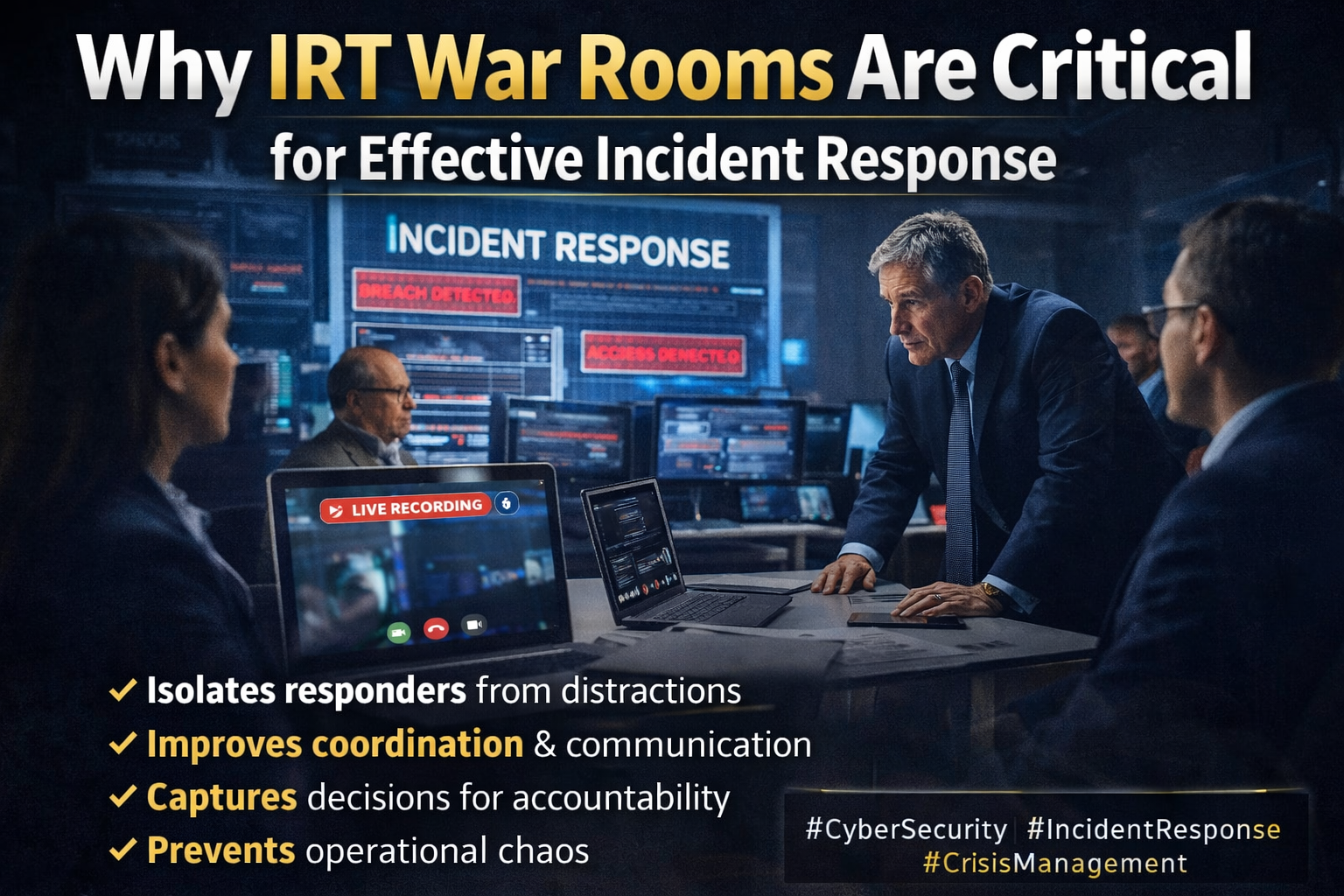
When a security incident escalates to Severity Level 2 or higher, establishing an Incident Response (IRT) war room becomes critical. A war room allows responders to step away from daily distractions, maintain focus, and work in a tightly coordinated environment. By isolating the response team, organizations reduce noise, prevent miscommunication, and enable faster, more accurate decision-making during high-pressure situations.
The war room is initiated by the incident lead and typically takes the form of a dedicated Zoom session that remains open throughout the active phase of the incident. Recording the session ensures that decisions, discussions, and actions are fully captured. Early in the meeting, a designated reporter is assigned to provide structured and periodic updates to key stakeholders who are not directly involved in the response, ensuring transparency without disrupting the response team.
Clear roles and accountability are essential in a war room. The team should reference the IRT RACI chart to announce major response functions and confirm ownership of each activity. Key milestones—such as completing a preliminary damage assessment—should be explicitly stated and shared as they occur. This structured approach ensures leadership and external stakeholders receive consistent, accurate updates aligned with the incident’s progression.
As response activities unfold, actions taken by the team should be clearly described and documented during the session. Capturing sufficient detail in real time helps preserve institutional knowledge and creates a reliable record of how the incident was handled. The communication method used should align with the severity level, ensuring the right balance between speed, accuracy, and control.
Once the Zoom recording is available, a transcript is generated and stored along with the recording in the organization’s IRT repository. The transcript is also uploaded to the document management system, where summaries can be produced for post-incident analysis, reporting, and continuous improvement. In my view, well-run IRT war rooms are not just operational tools—they are critical governance mechanisms that improve response quality, accountability, and long-term security maturity.
InfoSec services | InfoSec books | Follow our blog | DISC llc is listed on The vCISO Directory | ISO 27k Chat bot | Comprehensive vCISO Services | ISMS Services | AIMS Services | Security Risk Assessment Services | Mergers and Acquisition Security
At DISC InfoSec, we help organizations navigate this landscape by aligning AI risk management, governance, security, and compliance into a single, practical roadmap. Whether you are experimenting with AI or deploying it at scale, we help you choose and operationalize the right frameworks to reduce risk and build trust. Learn more at DISC InfoSec.
- AI Governance Enforcement: The Foundation for Scaling AI Governance Effectively
- Securing LLM-Powered Enterprises: From Invisible Threats to Operational Resilience
- Cyber Resilience Maturity Model: From Reactive Security to Operational Resilience
- From Risk to Resilience: A 5-Step Playbook for Securing AI in the Modern Threat Era
- Which AI Governance Framework Should You Adopt First? A Practical Guide for U.S., EU, and Global Organizations