
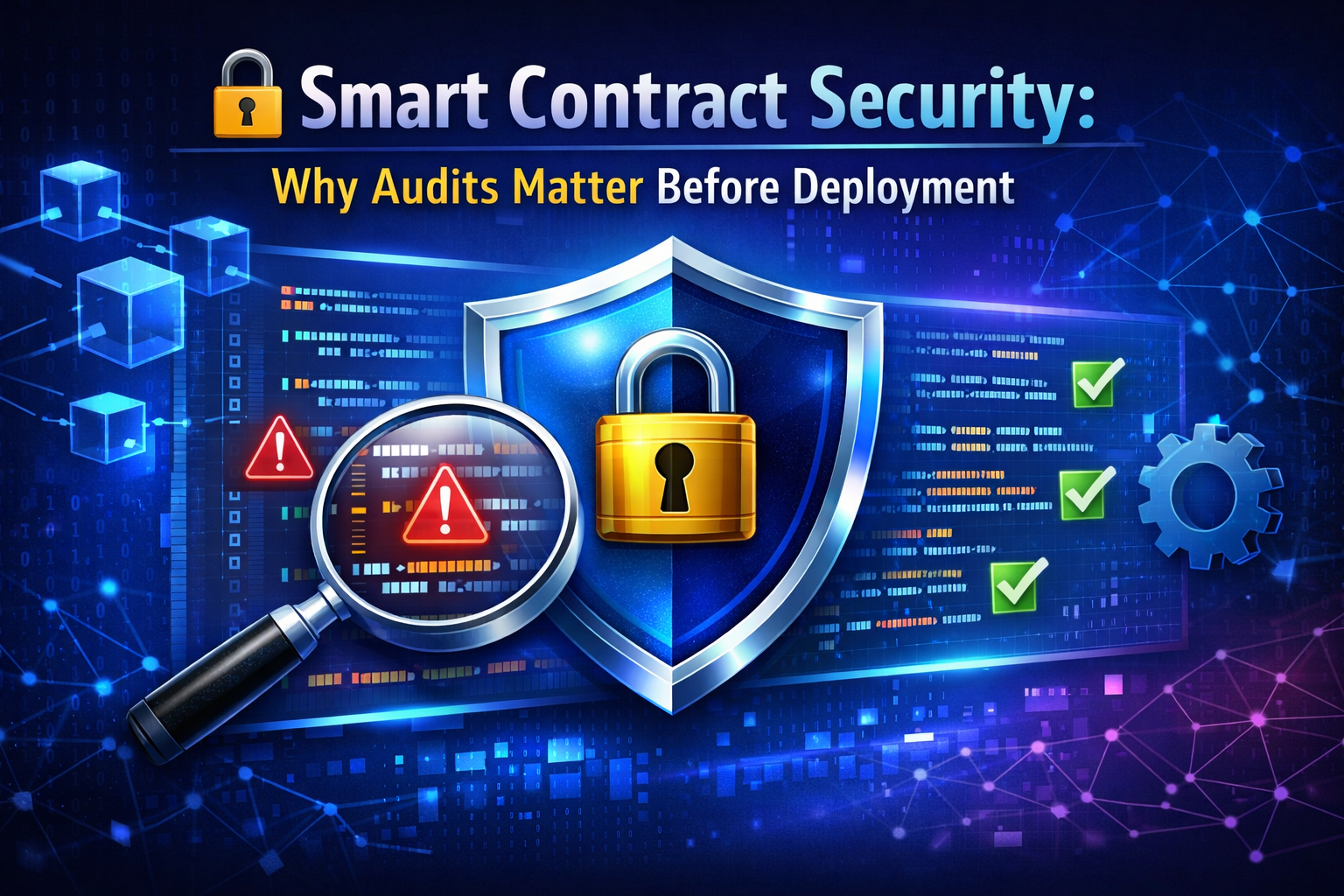
Smart Contracts: Overview and Example
What is a Smart Contract?
A smart contract is a self-executing program deployed on a blockchain that automatically enforces the terms of an agreement when predefined conditions are met. Once deployed, the code is immutable and executes deterministically – the same inputs always produce the same outputs, and execution is verified by the blockchain network.
Potential Use Case
Escrow for Freelance Payments: A client deposits funds into a smart contract when hiring a freelancer. When the freelancer submits deliverables and the client approves (or after a timeout period), the contract automatically releases payment. No intermediary needed, and both parties can trust the transparent code logic.
Example Smart Contract
// SPDX-License-Identifier: MIT
pragma solidity ^0.8.20;

contract SimpleEscrow {
    address public client;
    address public freelancer;
    uint256 public amount;
    bool public workCompleted;
    bool public fundsReleased;

    constructor(address _freelancer) payable {
        client = msg.sender;
        freelancer = _freelancer;
        amount = msg.value;
        workCompleted = false;
        fundsReleased = false;
    }

    function releasePayment() external {
        require(msg.sender == client, "Only client can release payment");
        require(!fundsReleased, "Funds already released");
        require(amount > 0, "No funds to release");

        fundsReleased = true;
        payable(freelancer).transfer(amount);
    }
}
Fuzz Testing with Foundry
// SPDX-License-Identifier: MIT
pragma solidity ^0.8.20;

import "forge-std/Test.sol";
import "../src/SimpleEscrow.sol";

contract SimpleEscrowFuzzTest is Test {
    SimpleEscrow public escrow;
    address client = address(0x1);
    address freelancer = address(0x2);

    function setUp() public {
        vm.deal(client, 100 ether);
    }

    function testFuzz_ReleasePayment(uint256 depositAmount) public {
        // Bound the fuzz input to reasonable values
        depositAmount = bound(depositAmount, 0.01 ether, 10 ether);

        // Deploy contract with fuzzed amount
        vm.prank(client);
        escrow = new SimpleEscrow{value: depositAmount}(freelancer);

        uint256 freelancerBalanceBefore = freelancer.balance;

        // Client releases payment
        vm.prank(client);
        escrow.releasePayment();

        // Assertions
        assertEq(escrow.fundsReleased(), true);
        assertEq(freelancer.balance, freelancerBalanceBefore + depositAmount);
        assertEq(address(escrow).balance, 0);
    }

    function testFuzz_OnlyClientCanRelease(address randomCaller) public {
        vm.assume(randomCaller != client);

        vm.prank(client);
        escrow = new SimpleEscrow{value: 1 ether}(freelancer);

        // Random address tries to release
        vm.prank(randomCaller);
        vm.expectRevert("Only client can release payment");
        escrow.releasePayment();
    }

    function testFuzz_CannotReleaseMultipleTimes(uint8 attempts) public {
        attempts = uint8(bound(attempts, 2, 10));

        vm.prank(client);
        escrow = new SimpleEscrow{value: 1 ether}(freelancer);

        // First release succeeds
        vm.prank(client);
        escrow.releasePayment();

        // Subsequent attempts fail
        for (uint8 i = 1; i < attempts; i++) {
            vm.prank(client);
            vm.expectRevert("Funds already released");
            escrow.releasePayment();
        }
    }
}
Run the fuzz tests:
forge test --match-contract SimpleEscrowFuzzTest -vvv
Configure fuzz runs in foundry.toml:
[fuzz]
runs = 10000
max_test_rejects = 100000
Benefits of Smart Contract Audits
Security Assurance: Auditors identify vulnerabilities like reentrancy attacks, integer overflows, access control flaws, and logic errors before deployment. Since contracts are immutable, catching bugs pre-deployment is critical.
Economic Protection: Bugs in smart contracts have led to hundreds of millions in losses. An audit protects both project funds and user assets from exploitation.
Compliance & Trust: For regulated industries or institutional adoption, third-party audits provide documented due diligence that security best practices were followed.
Gas Optimization: Auditors often identify inefficient code patterns that unnecessarily increase transaction costs for users.
Best Practice Validation: Audits verify adherence to standards like OpenZeppelin patterns, proper event emission, secure randomness generation, and appropriate use of libraries.
Reputation & Adoption: Projects with reputable audit reports (Trail of Bits, OpenZeppelin, Consensys Diligence) gain user confidence and are more likely to attract partnerships and investment.
Given our work at DISC InfoSec implementing governance frameworks, smart contract audits parallel traditional security assessments – they’re about risk identification, control validation, and providing assurance that systems behave as intended under both normal and adversarial conditions.
DISC InfoSec: Smart Contract Audits with Governance Expertise
DISC InfoSec brings a unique advantage to smart contract security: we don’t just audit code, we understand the governance frameworks that give blockchain projects credibility and staying power. As pioneer-practitioners implementing ISO 42001 AI governance and ISO 27001 information security at ShareVault while consulting across regulated industries, we recognize that smart contract audits aren’t just technical exercises—they’re risk management foundations for projects handling real assets and user trust. Our team combines deep Solidity expertise with enterprise compliance experience, delivering comprehensive security assessments that identify vulnerabilities like reentrancy, access control flaws, and logic errors while documenting findings in formats that satisfy both technical teams and regulatory stakeholders. Whether you’re launching a DeFi protocol, NFT marketplace, or tokenized asset platform, DISC InfoSec provides the security assurance and governance documentation needed to protect your users, meet institutional due diligence requirements, and build lasting credibility in the blockchain ecosystem. Contact us at deurainfosec.com to secure your smart contracts before deployment.
InfoSec services | InfoSec books | Follow our blog | DISC llc is listed on The vCISO Directory | ISO 27k Chat bot | Comprehensive vCISO Services | ISMS Services | AIMS Services | Security Risk Assessment Services | Mergers and Acquisition Security
At DISC InfoSec, we help organizations navigate this landscape by aligning AI risk management, governance, security, and compliance into a single, practical roadmap. Whether you are experimenting with AI or deploying it at scale, we help you choose and operationalize the right frameworks to reduce risk and build trust. Learn more at DISC InfoSec.
- Securing LLM-Powered Enterprises: From Invisible Threats to Operational Resilience
- Cyber Resilience Maturity Model: From Reactive Security to Operational Resilience
- From Risk to Resilience: A 5-Step Playbook for Securing AI in the Modern Threat Era
- Which AI Governance Framework Should You Adopt First? A Practical Guide for U.S., EU, and Global Organizations
- MITRE ATT&CK: Turning Blind Spots into Real-World Cyber Defense





