In a recent report, researchers at Cato Networks revealed that the “Skills” plug‑in feature of Claude — the AI system developed by Anthropic — can be trivially abused to deploy ransomware.
The exploit involved taking a legitimate, open‑source plug‑in (a “GIF Creator” skill) and subtly modifying it: by inserting a seemingly harmless function that downloads and executes external code, the modified plug‑in can pull in a malicious script (in this case, ransomware) without triggering warnings.
When a user installs and approves such a skill, the plug‑in gains persistent permissions: it can read/write files, download further code, and open outbound connections, all without any additional prompts. That “single‑consent” permission model creates a dangerous consent gap.
In the demonstration by Cato Networks researcher Inga Cherny, they didn’t need deep technical skill — they simply edited the plug‑in, re-uploaded it, and once a single employee approved it, ransomware (specifically MedusaLocker) was deployed. Cherny emphasized that “anyone can do it — you don’t even have to write the code.”
Microsoft and other security watchers have observed that MedusaLocker belongs to a broader, active family of ransomware that has targeted numerous organizations globally, often via exploited vulnerabilities or weaponized tools.
This event marks a disturbing evolution in AI‑related cyber‑threats: attackers are moving beyond simple prompt‑based “jailbreaks” or phishing using generative AI — now they’re hijacking AI platforms themselves as delivery mechanisms for malware, turning automation tools into attack vectors.
It’s also a wake-up call for corporate IT and security teams. As more development teams adopt AI plug‑ins and automation workflows, there’s a growing risk that something as innocuous as a “productivity tool” could conceal a backdoor — and once installed, bypass all typical detection mechanisms under the guise of “trusted” software.
Finally, while the concept of AI‑driven attacks has been discussed for some time, this proof‑of-concept exploit shifts the threat from theoretical to real. It demonstrates how easily AI systems — even those with safety guardrails — can be subverted to perform malicious operations when trust is misplaced or oversight is lacking.
🧠 My Take
This incident highlights a fundamental challenge: as we embrace AI for convenience and automation, we must not forget that the same features enabling productivity can be twisted into attack vectors. The “single‑consent” permission model underlying many AI plug‑ins seems especially risky — once that trust is granted, there’s little transparency about what happens behind the scenes.
In my view, organizations using AI–enabled tools should treat them like any other critical piece of infrastructure: enforce code review, restrict who can approve plug‑ins, and maintain strict operational oversight. For people like you working in InfoSec and compliance — especially in small/medium businesses like wineries — this is a timely reminder: AI adoption must be accompanied by updated governance and threat models, not just productivity gains.
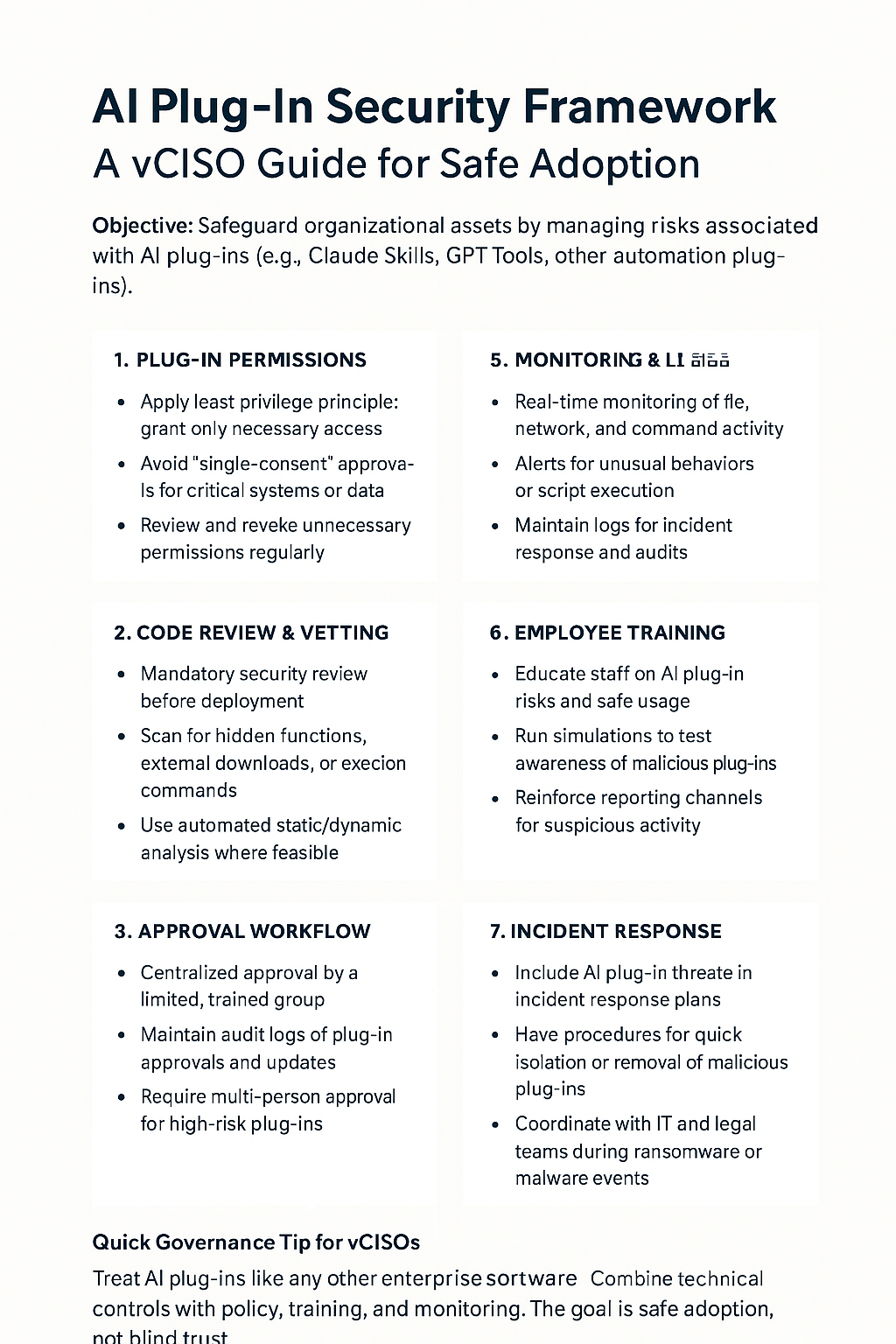
Below is a checklist of security‑best practices (for companies and vCISOs) to guard against misuse of AI plug‑ins — could be a useful to assess your current controls.
https://www.wired.com/story/the-era-of-ai-generated-ransomware-has-arrived
Safeguard organizational assets by managing risks associated with AI plug-ins (e.g., Claude Skills, GPT Tools, other automation plug-ins)
InfoSec services | ISMS Services | AIMS Services | InfoSec books | Follow our blog | DISC llc is listed on The vCISO Directory | ISO 27k Chat bot | Comprehensive vCISO Services | Security Risk Assessment Services | Mergers and Acquisition Security
Governance in The Age of Gen AI: A Director’s Handbook on Gen AI
- How ISO 27001 Lead Auditors Should Evaluate AI Risks in an ISMS
- Secure Your Web & API Applications Before Attackers Do: Reduce Vulnerabilities
- Is ISO 27001 Training Right for You? Here’s Who Should Consider It
- Top 15 Kali Linux Tools for AI Governance with Use Cases
- Risk Management with GRC platform: Mapping ISO 42001 Clause 6 to AI Governance