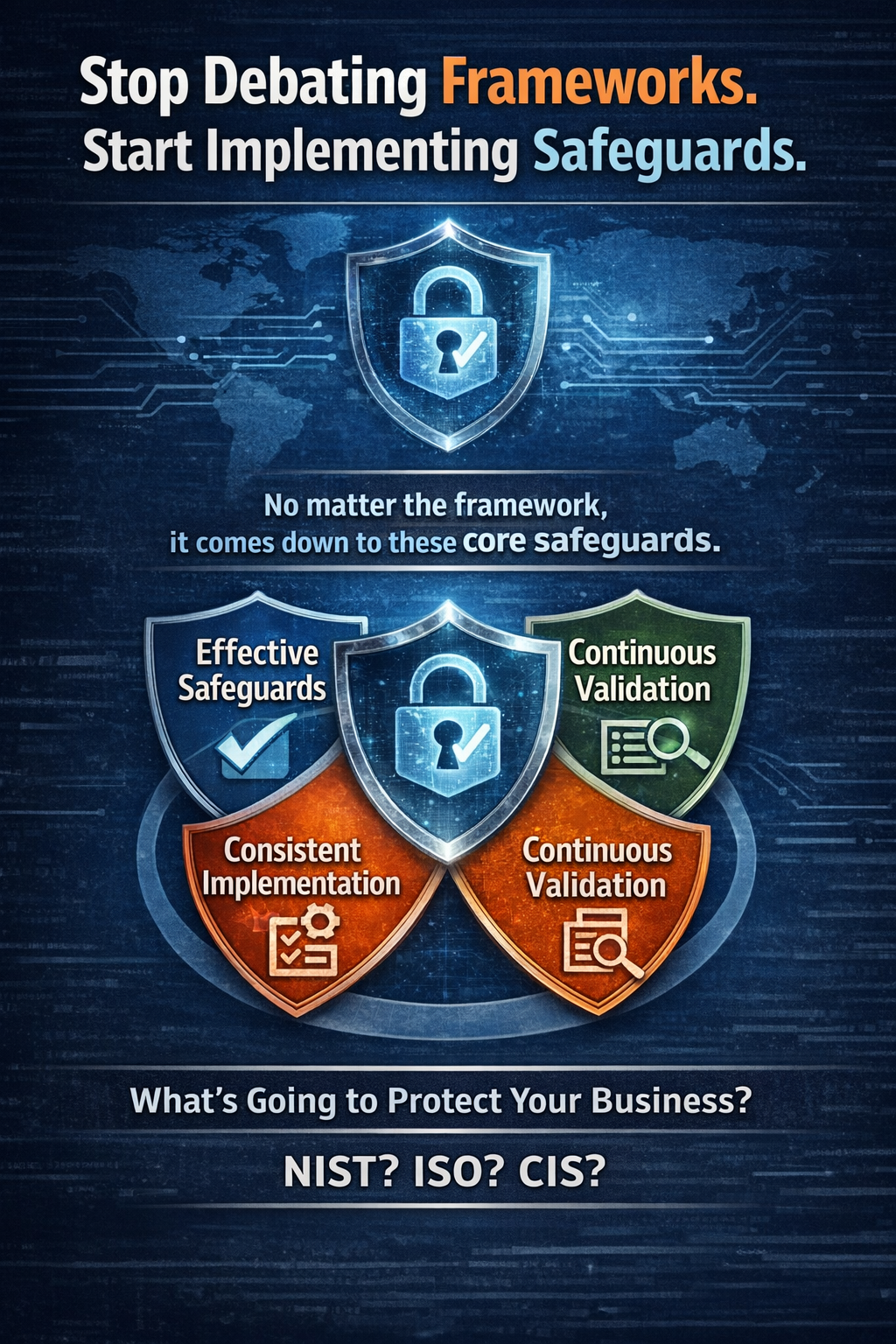
Organizations often spend an excessive amount of time debating which cybersecurity framework to adopt — whether it’s NIST, ISO, CIS, or another model. The discussion often becomes about reputation and recognition rather than measurable security outcomes.
But cybersecurity governance is not about choosing the most popular framework. Regulators, auditors, and executive leadership are not concerned with what is trending. They care about whether effective safeguards are implemented and functioning properly.
Across regulations, standards, and laws, there is growing alignment around a core set of expectations: governance structures, access controls, incident response capabilities, resilience planning, continuous monitoring, and accountability. While terminology may differ, the fundamental safeguards are largely the same.
The real questions organizations should be asking are straightforward: What controls protect critical systems and sensitive data? How consistently are they applied? How is effectiveness measured? And how are weaknesses identified and remediated over time?
When the focus shifts to clearly defined and properly implemented safeguards, mapping to different frameworks becomes much easier. Audits become more predictable, and governance conversations become practical instead of theoretical.
To address this challenge, work has been underway to aggregate and refine common safeguard expectations across numerous regulatory and standards sources. The goal is to simplify how organizations understand and implement what truly matters.
Soon, the Cybersecurity Risk Foundation will release an updated version of the CRF Safeguards — a free, aggregated safeguard model compiling nearly 100 safeguard libraries. It is designed to help organizations move beyond framework branding and concentrate on the safeguards that actually reduce risk.
My perspective:
Framework debates often distract from the real issue. Security maturity does not come from adopting a label — it comes from disciplined implementation, measurement, and continuous improvement of safeguards. Organizations that prioritize substance over branding are typically the ones that withstand audits, reduce incidents, and build long-term resilience.

InfoSec services | InfoSec books | Follow our blog | DISC llc is listed on The vCISO Directory | ISO 27k Chat bot | Comprehensive vCISO Services | ISMS Services | AIMS Services | Security Risk Assessment Services | Mergers and Acquisition Security
At DISC InfoSec, we help organizations navigate this landscape by aligning AI risk management, governance, security, and compliance into a single, practical roadmap. Whether you are experimenting with AI or deploying it at scale, we help you choose and operationalize the right frameworks to reduce risk and build trust. Learn more at DISC InfoSec.
- You can’t put a human in the loop of a system that kills its agents every 3 minutes
- Human Oversight vs Human Control: Where the Human Sits in AI Execution
- A signed two-page policy beats a fifty-page draft. Every time…
- We have guardrails for that is not a control – Here’s the difference
- Point-in-time remediation is dead against a persistent adversary